Gates of Sattva
The Year the City Asked Everything and He Had Nothing Left to Give
There are years that pass like seasons.
And then there are years that pass like surgeries.
Slow. Necessary. And leaving marks that never quite disappear.
This was that year.
The taxi became his world.
Not by choice — but then, the most defining chapters of a man's life rarely arrive by invitation. They arrive the way winter arrives. Not asking permission. Simply appearing one morning, settling in, and making themselves entirely at home.
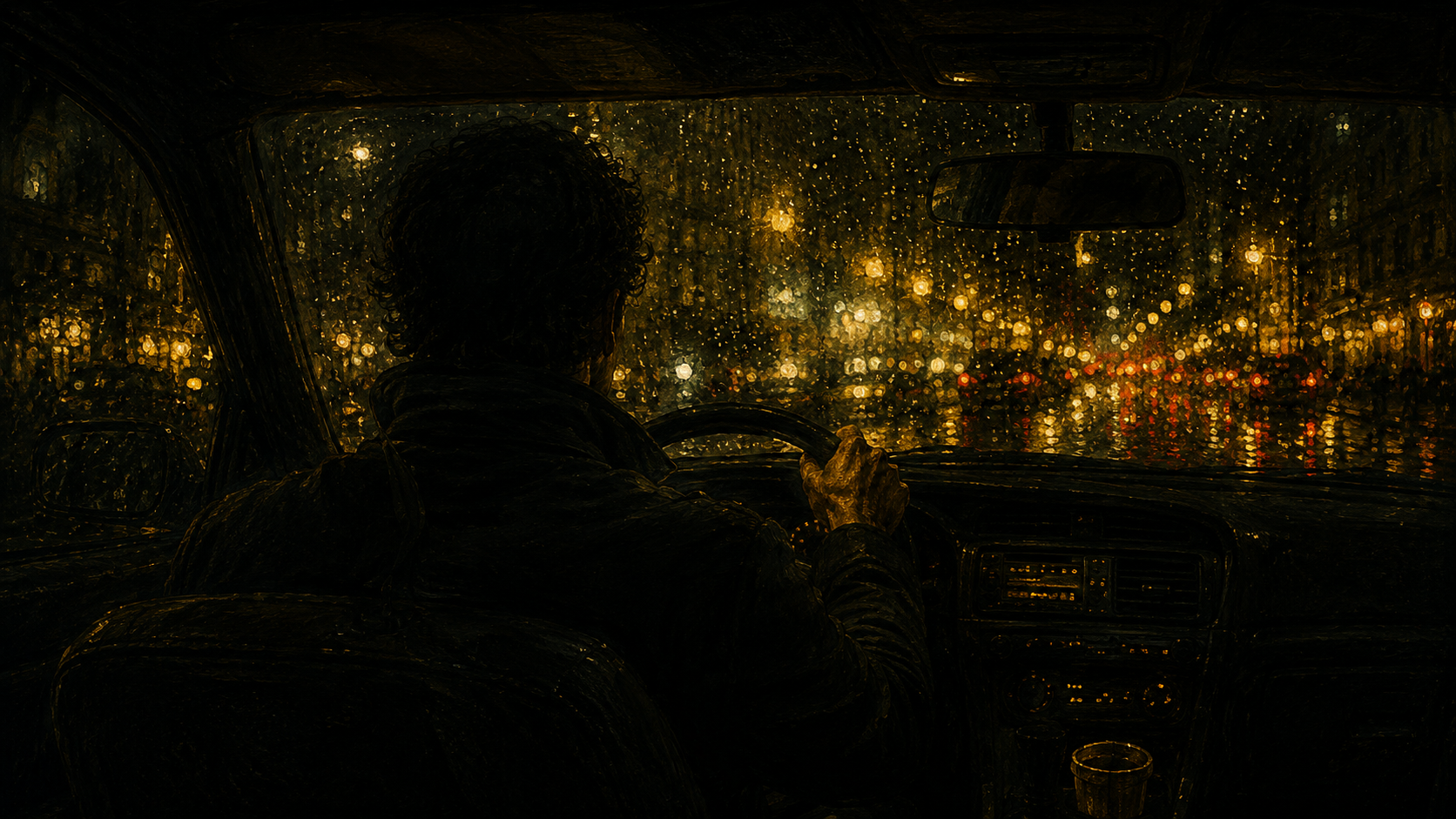
He drove. Morning into afternoon. Afternoon into evening. Evening into the kind of night that belongs to a city's hidden life — the last trains, the quiet streets, the sodium glow of lights that never turn off because Toronto, like all great cities, does not believe in darkness.
Money was not a surplus. It was a calculation. Precise and unforgiving. Every kilometre weighed against every bill. Every fare measured against what waited at home. A pregnant wife. A life being assembled from almost nothing in a country that had promised much and delivered something considerably more complicated.
There were no breaks.
This is not poetry. This is the plain, unglamorous truth of a man with no safety net and no margin for pause.
He kept a cup in the car.
The city did not stop for him. So he did not stop for the city.
And yet.
Somewhere in those long stretches of Toronto night, somewhere between the dispatch calls and the quiet passengers and the kilometres that blurred into one another — there was a radio.
Another day in paradise.
Phil Collins. A song about the invisible people. The ones the city steps around without seeing. The ones who are always there and never quite noticed.
He listened to it the way a drowning man listens to a voice calling from the shore.
Not because it gave him answers.
Because it told him someone, somewhere, had seen what he was living. Had put it to music. Had decided it was worth remembering.
That is sometimes enough.
Not to fix anything. Simply to survive the night.
The ancient wisdom that would later find him — though he did not know it was coming — speaks of a fire that lives at the centre of every human being. Not metaphor. The teachers meant it literally. A metabolic, spiritual, deeply physical flame that governs how we digest not only food but experience. Grief. Loss. Exhaustion. Uncertainty. The body processes all of it. And when asked to process too much, for too long, without rest or nourishment — the fire does not rage. It quietly dims.
He could feel it dimming. He simply had no name for what was leaving him. The body was keeping its record. Page after page after page.
If you find yourself in a season like this one — the long nights, the body running on empty, the weight of a life being held together by sheer will — the ancient practice offers something immediate. Not a cure. A compass.
Five minutes before you sleep tonight
- 01
Warm your hands
Rub them together for thirty seconds. Place them gently over your eyes. Let the warmth settle. This is not routine. This is a signal to your nervous system that the day is finished and it is safe to rest.
- 02
One deep breath in for four counts
Hold for four. Out for six. Do this three times. The extended exhale activates the part of your nervous system that heals while you sleep.
- 03
A glass of warm water with a pinch of cardamom
Not tea. Not a supplement. Simply this. Cardamom has been used in Ayurvedic practice for centuries to calm the digestive fire that stress inflames — the burning, the restlessness, the body that refuses to wind down.
- 04
Name one thing that kept you going today
Not a gratitude list. Just one thing. The way he had his — a heartbeat growing across the city. One thing is enough. One thing is everything.
- 05
Put your phone face down
The city will still be there in the morning. Tonight, you have done enough.
For those looking to understand the deeper language their body has been speaking — our book explores the intersection of ancient Ayurvedic wisdom and the modern life that quietly dismantles us. Not theory. A map, written from the inside of the experience.
The baby kept him driving.
This is the entire truth of that year, distilled to its simplest form.
Not ambition. Not pride. Not some grand vision of the future he was building. Just the quiet, animal certainty that somewhere across this indifferent city, a heartbeat was growing that was partly his. And that heartbeat needed him to keep moving.
So he kept moving.
Through exhaustion that lived in his bones. Through a back that protested every shift and a body that had been filing grievances for years without ever receiving a response. Through mornings that arrived before he had finished with the night.
He drove.
Because a man will find strength for the things that matter when every other source of strength has long since run dry.
This is not remarkable. Every parent knows it.
But living it — alone, in the dark, with Phil Collins and a cup and the quiet hum of a city that did not know his name — that is something else entirely.
There is a particular kind of loneliness that has nothing to do with being alone.
It is the loneliness of carrying something too heavy to put down and too precious to share. Of looking at the person you love most and choosing silence because the full weight of the truth would only add to their burden.
He carried it quietly.
As men are taught to do.
As men, eventually, must unlearn.
The body, by this point, had stopped whispering. It was not yet shouting. But it was speaking clearly, in the language of pain and disruption and a tiredness that sleep alone could not touch. Something was coming. A reckoning. Not punishment — the ancient teachers are careful to make this distinction. Simply the inevitable moment when what has been ignored for long enough demands finally to be seen.
He was almost ready to look. Almost.
Continue the Series →
The Day His Eyes Finally Said Enough