Gates of Sattva
The Day His Eyes Finally Said Enough
There is a moment in every man's story where the ground he has been standing on — however cracked, however unsteady — finally gives way entirely.
Not a slow erosion.
A sudden, complete, and total collapse.
This was that moment.
He sat in the doctor's office the way a man sits when he already knows the news will not be good. The kind of sitting that is less about comfort and more about bracing. The body preparing itself before the mind has caught up.
The diagnosis was not loud. Medical verdicts rarely are. They arrive quietly, in measured language, delivered by someone trained to hold composure so that the person across the desk has permission to lose theirs.
Central Serous Retinopathy.
Stress had reached his eyes.
Not his sleep. Not his digestion. Not his back or his shoulders or the thousand other places his body had been quietly registering its objections for years.
His eyes.
The windows, the ancient teachers say, through which the soul looks out at the world.
Something broke open in him then.
Not gently. Not philosophically. Not in the measured, reflective way that difficult moments are described once enough time has passed to soften their edges.
It broke open the way a dam breaks. Completely. Without warning. Without dignity.
He wept.
Not the quiet weeping of a man composing himself in private. The weeping of a man who has carried an impossible weight for an impossible length of time and has simply, finally, run out of arms.
How much more?
The question was not asked of the doctor. It was not asked of anyone in that room. It was asked of something larger. Something that had been arranging the circumstances of his life with what felt, in that moment, like extraordinary and personalised cruelty.
How much more is destiny going to take before it is satisfied?
The ship. The surgeries. The ocean left behind. Canada and its gleaming, indifferent promise. The retail shelves. The accident. The financial collapse. The taxi and the cups and the nights that Phil Collins got him through when nothing else could.
And now this.
His eyes.
He blamed the country.
This too is human. Entirely, completely human.
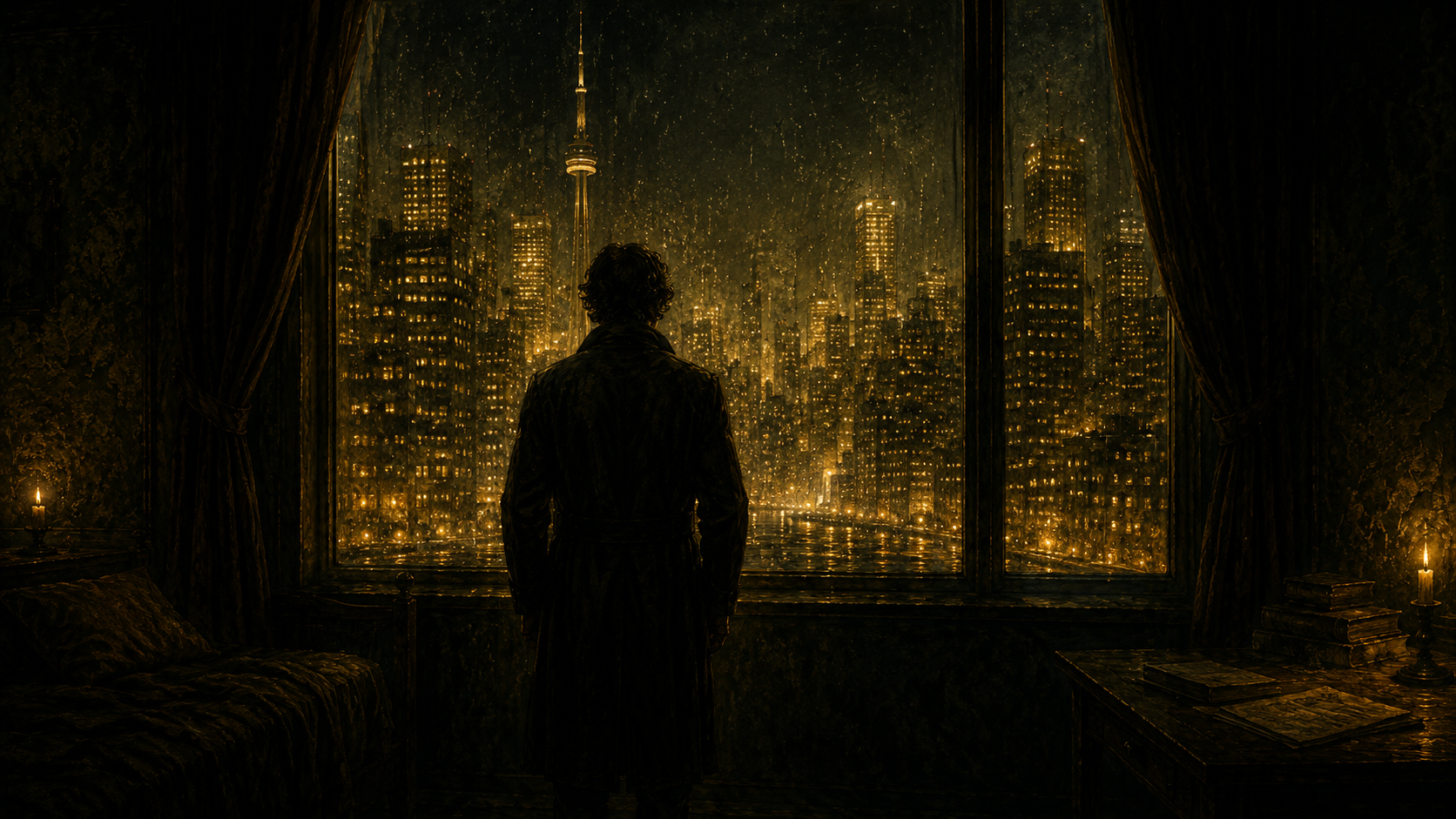
When pain has no acceptable target, it finds one. The mind, desperate for an explanation that makes sense of what feels senseless, reaches for the nearest available answer. And the nearest available answer, in that doctor's office in Toronto, was the city itself. The country. The choice to cross the ocean in the first place.
I should never have come here.
This place did this to me.
I was better before.
Perhaps he was. Perhaps the ocean had been better. Perhaps the life left behind, for all its suffering, had at least been a suffering he understood.
But the ancient teachers — who had seen this moment in ten thousand different lives across ten thousand different centuries — would have recognised what was happening with precise clarity.
This was not the country breaking him.
This was everything he had refused to put down, finally becoming too heavy to carry.
This was the body delivering, with the only language loud enough to be heard, the message it had been composing for years.
Stop.
Not tomorrow. Not when things improve. Not when you have more money or more stability or more certainty about the future. Now.
In Ayurvedic understanding, the eyes are governed by the same energy that governs transformation, perception and clarity. When this energy — already overworked, already inflamed by years of stress and sleeplessness and grief — has nowhere left to go, it rises. It finds the most sensitive, most perceptive part of the body. And it settles there.
The ancient healers would not have been surprised by his diagnosis. They would have been surprised it had taken this long.
What they would have prescribed is not what he expected. Not more. Not harder. Not push through.
Less. Slower. Quieter. The radical, almost rebellious act of rest.
If your body has been speaking in ways you have been too busy to hear — if the signs are there and you have been negotiating with them the way he did, for years, because stopping felt impossible — these are the five things the ancient practice asks of you first.
- 01
Stop before you are forced to
The body will always eventually win this negotiation. The only question is whether you choose the terms or it chooses them for you.
- 02
Reduce what enters your eyes at night
Screens carry a particular kind of stimulation that the visual system — already under stress — cannot process and release before sleep. One hour before bed, let your eyes rest in low, warm light. Candlelight if you have it. This is not indulgence. This is maintenance.
- 03
Apply warm ghee to the soles of your feet before sleep
Ancient Ayurvedic practice. The feet carry marma points — energy pathways — that connect directly to the nervous system. Warmth here travels upward. It settles what stress has scattered.
- 04
Eat before the sun fully sets
The digestive fire — already compromised by years of irregular meals and night shifts — works with the body's natural rhythm, not against it. A light, warm meal before dark asks less of a system that has been asked too much.
- 05
Speak what you are carrying
To someone. To a page. To the empty passenger seat of a taxi at 3am if that is all that is available. The body stores what the voice refuses to release. Spoken grief moves. Unspoken grief accumulates.
Our books were written inside this exact experience — not looking back at it from a safe distance, but from within the wreckage, finding the ancient words that finally made sense of what the body had been trying to say all along.
And if someone in your life is carrying more than they are showing — this is the book you give them.
He drove home from that appointment a different man than the one who had driven to it.
Not healed. Not transformed. Not suddenly in possession of answers he had not had that morning.
But cracked open.
And sometimes — the ancient teachers are very clear on this — a crack is the only way the light finds its way in.
He did not know it yet.
But the turning point had arrived.
It simply did not look the way turning points are supposed to look.
It looked like a man crying in a car in a Toronto parking lot.
Asking the sky how much more.
Not yet knowing the sky was finally, quietly, about to answer.
Continue the Series →
The Root That Remembered What He Had Forgotten